
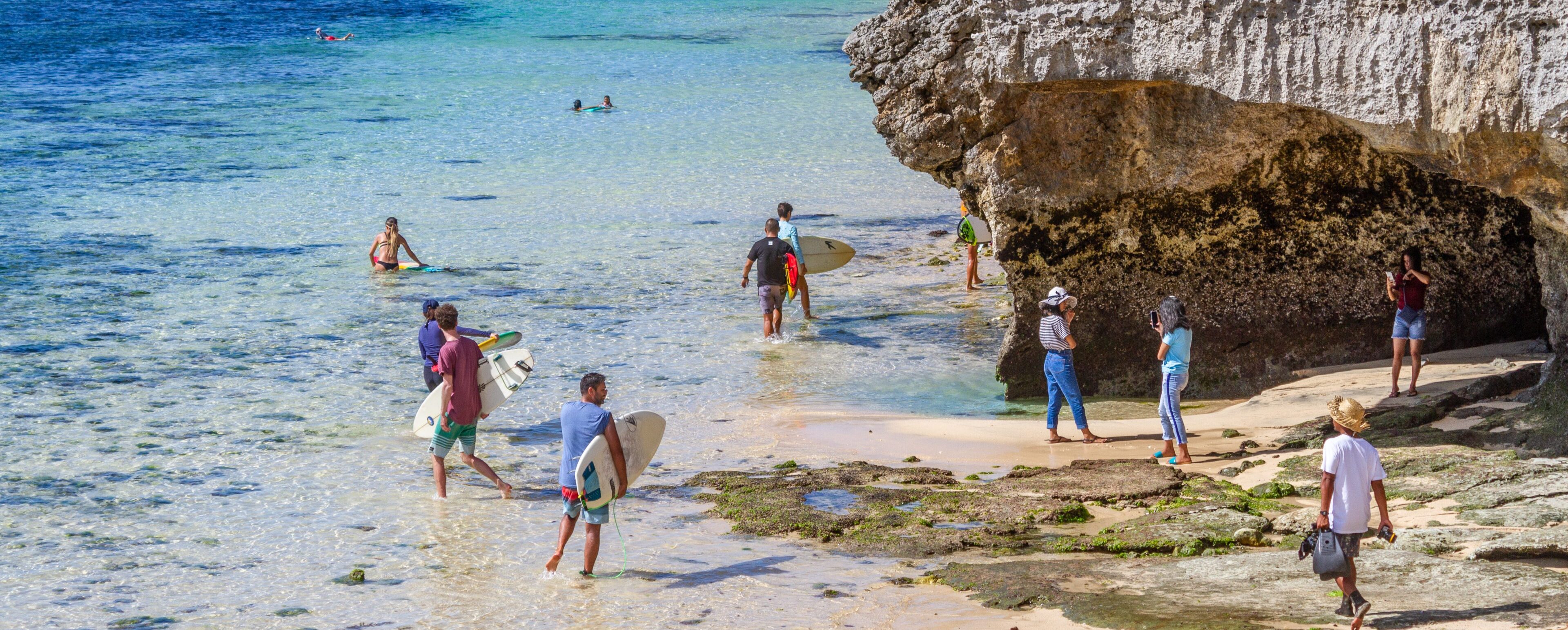
The Complete Guide To Surfing Nusa Dua
Nusa Dua (“two islands” in English) was developed as a purpose-built tourism resort in the 1970s and 1980s by the Indonesian government, in collaboration with international and local organisations.
Download our free PDF guide to all 75 Bali surf spots to plan your trip around the right break for every tide, swell and wind.
The infrastructure was carefully planned for international tourists, with luxury resorts, golf courses, convention centres, and other amenities. The area was designed as a safe, controlled environment, which is why it is a gated community with controlled access points.
Nusa Dua is known for its five-star hotels, white-sand beaches, and world-class facilities, making it popular for both leisure and business travellers. In 2022 it hosted the G20 and it regularly hosts prestigious international conferences.

The Bukit (hill, in English) is renowned for the quality, quantity, consistency, and variety of surf breaks packed into such a small area. In the wet season, the prevailing winds in Bali often come from the south-west or west, which means Nusa Dua is offshore on the leeward side. This results in calmer, less windy conditions on the Nusa Dua beaches, making it a sheltered, pleasant location at this time. Wind speed on the beach here is generally about half the strength of more exposed locations, thanks to the protection of the Bukit and the shoreline buildings.
Getting to any of the Nusa Dua breaks from our Uluwatu surf camp is easy, as we are strategically located for all the Bukit surf breaks. Nusa Dua has many pristine beaches and is our go-to location in the rainy season, when it is onshore at the Uluwatu-area surf breaks.
All of the Nusa Dua surf spots are offshore when the famous reef at Uluwatu is onshore. Depending on the tide and swell size, there are options for beginner, intermediate, and advanced surfers. While Nusa Dua is known as a wet-season location, it can also be surfed in the dry season in the early morning, before the trade winds kick in and blow it out around mid-morning.
A guide to every Nusa Dua surf spot
Nikko
Nikko (also known as Nico beach) is the most southerly of the Nusa Dua breaks, directly in front of the old Hotel Nikko, now renamed the Hilton Bali Resort. Nikko was a secret spot for many years but was put on the surfing map in 2016, when a jetty was extended into the surf break.
The jetty reduced the size of the surfing area. Previously, Nikko was a very long, flawless white-sand beach with a huge area to surf; now the area is much smaller, but the nature of the wave is much the same. Nikko is a fast right-hander that barrels and works best at mid to high tide. Not many people surf it since the jetty was built, as the popular view is that the wave is ruined. It is still a good-quality wave, but for advanced surfers only, due to its speed and power, and many goofy-footers find it breaks too fast.
Geger Left
Geger Left is a low-tide wave that has become popular recently. It works up until mid-tide, but at high tide the water is too deep for the wave to break. It is not suitable for beginners, due to the strong current and the distance it breaks from shore. The end section has a bowl that looks like a Mentawais-type wave, caused by the deep-water channel, where the wave moves at different speeds over the different depths. When the surf is small, the end section suits intermediate surfers, as the wave fattens in the deep-water channel. It is a short ride but fun, with an easy paddle back out in the channel if you make it to the end. The better your surfing, the deeper you can take off and still make the wave.

Further north up the reef, towards Geger Right, there are various fast, shifty peaks. On big days these are for advanced surfers only. The wave will occasionally barrel and there are some fun sections, but generally it is a short ride that will always close out. For the paddle out, it is best to follow the coastline to the south before starting to paddle, taking a circuitous route to the break. Save energy for the paddle back, as the current works against you and can be a long, hard slog at mid-to-high tide. Head directly for land coming in, and ideally catch a whitewater wave to push you part of the way.
Geger Right
Geger Right is located near the Bali National golf course and was the original go-to wave in Nusa Dua; when people talk about surfing Nusa Dua, by default they mean Geger Right. Very deep water offshore amplifies the swell. It picks up the most swell on the east coast and is never flat. It holds huge swells and is for experts only when more than double overhead, due to the risk of clean-up sets and strong currents that mean endless paddling.

Geger is a high-quality performance wave, but the strong current makes it hard to hold position and even harder to paddle back after a wave. We only take advanced surfers to Geger Right, because the current is very strong and it can be hard to get back out through the whitewater after riding to the inside. One tactic we use is to start at the first peak in the far south and work down the sections, ending at Chicken Wings. A one-hour session here is like surfing two hours anywhere else, and it will feel like three if you get caught inside by a set or two. Geger Right can be surfed at all tides, but mid-to-high is best. At low tide you can walk across the reef; when there is enough water, we recommend taking a boat to first peak. Jumping off the boat can be intimidating on a big day, and it is disorientating at first to line up, as you access the break from the back. If you are lucky, you will catch a set wave on the way and ride it all the way to Chicken Wings.
Chicken Wings
Chicken Wings is the last section of Geger Right and is popular with intermediate surfers. Geger Right does not usually link up with Chicken Wings; there is a deep-water section where the wave ridden from Geger Right usually fattens out. Despite the name, Chicken Wings is a high-quality wave, very suitable for advanced surfers who want to avoid the much stronger current at Geger. It works best at mid-to-high tide and is best accessed by boat from Mengiat beach. A one-way drop from the boat is a good option if you are not sure when you want to be picked up, as the current runs back towards where you took the boat. The rides can be very long, and the right wave will take you half the way back to Mengiat. Chicken Wings is one of our favourite waves when the wind is westerly or south-westerly on a medium swell; the current is not as strong as Geger, and getting caught inside is not so punishing.

Mengiat
Mengiat is very easy to access, beautifully located in the middle of a long, pristine white-sand beach. You enter the car park via a manned gate into an area of well-manicured tropical gardens, an oasis compared with the bustling streets outside, and it is a very short walk to the break. At mid-tide on the inside there is a section suitable for beginners on a small swell; on a bigger swell there is too much current to be safe for beginners.

Mengiat breaks both left and right and works best at mid-to-high tide. It suits intermediate surfers on a small swell and advanced surfers when overhead. The peak is shifty and the left generally works best. There is a current running, which adds to a difficult take-off, and the rides are usually short. The left has an interesting bowl on the end section, where there is a deep-water channel, which is also the easiest place to paddle out. The waves look perfect from the beach, but it is a fast wave and hard to get in the right position. Mengiat is a fickle wave that does get good, but is usually a little disappointing.
Black Stone
Black Stone has a peak that forms from the bounce off the island separating it from Mushroom Rock. It can be a very challenging take-off, suitable only for advanced surfers, due to the speed the wave forms and its steepness. There is a short right-hander off this peak, but the left usually offers the longer ride.

At low tide the wave closes out and is not surfable. It needs a big swell to break at high tide, but the spot does not hold a big swell or high period. It is best at mid-tide when the wave period is around 12 or 13 seconds; at high tide on a small swell the water is too deep for it to break. High-period swells make the wave wonky, so go elsewhere if the period is 14 seconds or more. Black Stone can be very good, but it is fickle with a tricky take-off. On a spring tide, there is a maximum of about one hour on the incoming and outgoing tide when the depth is optimal; neap tides are best, as the tide stays at mid-tide for much longer with less water moving. Intermediate surfers are usually best sitting on the inside, away from the peak, where it is a little more mellow. Another 50 metres south, towards Mengiat, there is a spot suitable for beginners on a small swell.
Mushroom Rock
Mushroom Rock is a high-tide right-hander that breaks very fast. On the biggest swells it breaks very heavily and is experts only. Most days it suits intermediate and advanced surfers, though many of the waves break too fast for goofy-footers. It is not suitable for beginners, due to the paddle distance and the fact the whitewater does not run far, fattening out in deep water.

The quickest way to access the break is to jump off the headland that separates Mushroom Rock and Black Stone. It is not particularly difficult for advanced shortboarders to get in from the rock. For intermediates on fun boards, we recommend paddling from the beach. It is not practical to climb up the headland to exit, so paddle directly to shore at the end of your session. Mushroom Rock is protected from a south-westerly wind by the rocky headland; if Mengiat and Black Stone are choppy from a cross-wind, you will often find Mushroom Rock much cleaner.
Mushroom Secrets
Mushroom Secrets is located to the north of the second island that gives Nusa Dua its name. It is an almost exact copy of Mushroom Rock, a right-hander best at high tide, except the wave is always smaller and breaks softer. If Mushroom Rock is too big or too crowded, it can be worth a walk up the beach to check Mushroom Secrets, which works on the same winds. As the wave breaks softer and slower, it can be a good spot for beginner surfers.

Sri Lanka
Sri Lanka is the crème de la crème of the Nusa Dua breaks, one of the best right-handers in Bali and the go-to on a big swell in the rainy season. The rainy season usually has smaller swells, so most days there is not enough swell for Sri Lanka to break well. The best months are during the changeover of seasons, March–April and October–November, when you can expect some solid swells with light, variable winds. Sri Lanka needs to be around double overhead on the sets to break optimally, and is suitable only for advanced surfers when there is a decent swell running. It holds triple overhead and throws huge stand-up barrels.
Sri Lanka has a fast take-off, and you need to angle your board to make the first section; the further up the point you sit, the harder it is. The correct place to line up depends on your skill level and stance. Sri Lanka never closes out, as the wave fattens in a deep-water channel; if you hear someone say it closed out, they took off too deep or were not fast enough. Insider tip: paddle very hard at an angle to get onto the wave and line up for the take-off and first section. If you paddle straight for shore, the wave will overtake you and you will be riding whitewater. When the wave is head-high it suits intermediate surfers, but any smaller and it does not break properly, in which case head south to a break that picks up more swell. Getting in and out from the jetty is tricky, over green, slimy, slippery stones, so if you are not confident, paddle out from the beach. Sri Lanka breaks some distance from shore and is not suitable for beginners. It is directly in front of Club Med and is within walking distance of Mushroom Rock.
Benoa
Benoa is an incredible multi-peak wave that is often overlooked because it is so far offshore and away from the crowds. It picks up the least swell in Nusa Dua and needs a large swell to turn on, but a perfect session here can make your whole holiday. Beginners should not surf here, due to the dangerous currents and offshore location, but intermediates can find fun waves. Access is tricky: the spot is near the watersports area about 1km north of Sri Lanka, and while you can walk part of the way out at low tide (booties recommended), the long paddle at mid-to-high tide is challenging due to strong, dangerous currents, making a boat the preferred option, though coordination is harder.
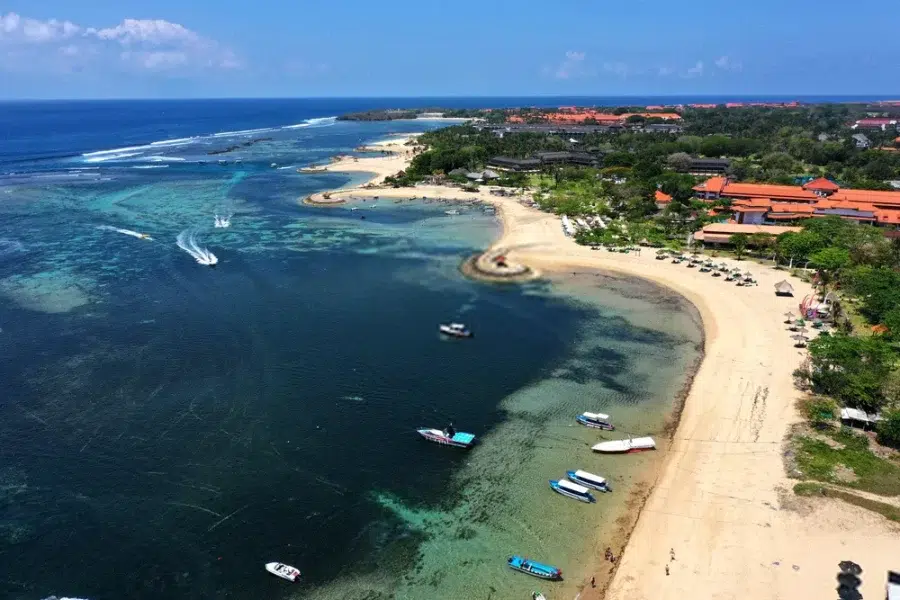
The break works on all tides: on smaller swells, high tide is a mellow longboard wave, but on large swells it turns on for advanced surfers and experts at low tide. Benoa has three peaks: an outside left, a shifty bowl with an incredibly long ride (200m+) best for advanced surfers; an inside left, half the size and suitable for intermediate surfers at mid-to-high tide; and a top-quality, barrelling right-hander that is steep, fast, and best for expert surfers. This wave is underrated because it lacks the hype and easy access of waves like Keramas, which is exactly why we like it.
Can beginners surf Nusa Dua?
Yes, some spots suit beginners when the swell is small, but it is critical to know exactly where and when to go. Mushroom Secrets is a great option, with an inside section protected from the main swell by the isthmus, creating a gentle reform perfect for whitewater. The inside sections of Mengiat and Black Stone are also suitable on a small swell. However, many breaks are far from shore and affected by currents too strong for beginners, such as Benoa, Mushroom Rock, and Geger Left. As all the breaks are coral reef, and the right place to surf depends heavily on tide and swell size, we recommend beginners book beginner surf lessons with an instructor experienced in these reefs. In the dry season, our beginner groups surf the gentle waves at Baby Padang on the Bukit.
Can intermediates surf Nusa Dua?
Yes. Nusa Dua offers fantastic waves for intermediates, particularly in the wet season, but it takes local knowledge to navigate safely. Most spots work when the swell is shoulder-to-head high. For fun waves and fewer crowds, Mushroom Secrets offers right-hand walls on its outside peak on medium-to-large swells. Black Stone is a good choice when the swell is smaller (shoulder-high and below), offering a fast but manageable ride. There is also the less current-affected Chicken Wings (the tail of Geger Right) and the end section of Geger Left when the surf is small. Intermediates must be very aware of the strong currents here, particularly at Geger Right, and complex offshore waves like Benoa have strong currents, tricky boat access, and specific tidal needs. We recommend intermediates book intermediate surf lessons with us, particularly for the more complex spots, where the combination of swell, current, and tide is too dangerous to manage alone.
When is the best time to surf Nusa Dua?
The best time to surf Nusa Dua is usually the rainy season, from November to March, when the wind is predominantly from the west and south-west. This is also the busiest time. April and October are excellent, as the winds are generally light and variable and the popular Uluwatu-area spots are also working, which spreads the crowds. Insider tip: you can often score Nusa Dua empty in the dry season between May and September. Early mornings can be windless if you are lucky, but usually the trade winds kick in by around 9am or 10am.

July and August are the worst months, as the trade winds are very strong and it is likely to be windy even at first light. The good thing about Nusa Dua is that it handles any swell size, and even on the windiest days in January the wave quality can be very good, as the wind will be direct offshore or cross-offshore. Breaks close to shore, like Black Stone and Mengiat, can be best when the wind is howling; Sri Lanka and Mushroom Rock can be best when the wind is cross-offshore or sideshore at Geger.
Where to stay in Nusa Dua
Nusa Dua is well known for the luxury resorts lining its shoreline. The best, and most expensive, are the Ritz-Carlton, the Westin, the Mulia, the Sofitel, and the Hilton. On the same stretch, a little more dated and less expensive, is the Grand Hyatt, located midway between Black Stone and Mengiat beach. There are also some budget hotels a little inland; we can recommend the Palm Bamboo Hotel, Sunrise Aventus, and Kubu Garden Suites.
Where to eat in Nusa Dua
Most of the dining is in the hotels near the beach. The Mulia offers what we would rate among the best buffets in Bali, with teams of chefs freshly cooking Indian, Indonesian, Japanese, and Italian dishes, and excellent seafood. The Westin has an excellent Spanish restaurant we can recommend, and the best restaurant outside the chain hotels is the Nusa Dua Beach Grill, overlooking Geger beach.
What to do in Nusa Dua for non-surfers
Benoa, at the northern end of Nusa Dua, is the watersports capital of Bali, with jet skis, parasailing, banana-boat rides, wakeboarding, and water-skiing from various operators offering competitively priced packages. Nusa Dua also has pristine white-sand beaches, ideal for walking and relaxing, and a world-class golf course. The Pasifika Museum holds Asian and Pacific art, and there are Indonesian cultural performances to see.
Why surf Nusa Dua with us
Nusa Dua offers a variety of high-quality advanced waves, fun intermediate waves, and a few beginner spots. Geger is never flat, and there is always somewhere to surf, whatever the tide and swell size. The aim of this guide is to help you pick the best spot for your ability on any given day, according to swell, wind, and tide. Geger holds a big crowd, thanks to the size of the reef; the same can no longer be said for Nikko, but Nusa Dua has many surf spots along the 6-mile stretch from Nikko to Benoa. If you want to surf the best waves Bali has on any given day, join our Uluwatu surf camp, as we are strategically located close to all the best breaks.